5 reasons for doing online learning for school students well
13 April 2020


Still Alive in 2025
30 January 2026
I am both shocked and embarrassed that we are hurtling towards February and I am only now getting this review of 2025 out the door. If anyone asks, it is because I was initially blissfully pre-occupied on a Christmas cruise with my family (it was my first, but it won’t be my last). And, subsequently, because I was being kept busy with work. Both are true. But the shameful reality is that both are also convenient excuses, permitting me to deliberately avoid a task where I feared I had little to say. However, now I have taken myself in hand and looked back over the year, it has been surprisingly therapeutic. While there were periods in 2025 when my consultancy was on life support (which my mind has a nasty habit of giving more weight to than they deserve), for most parts, DXP Consulting was still alive and well in 2025. And there were instances where it was thriving. Some highlights during the year were:
-
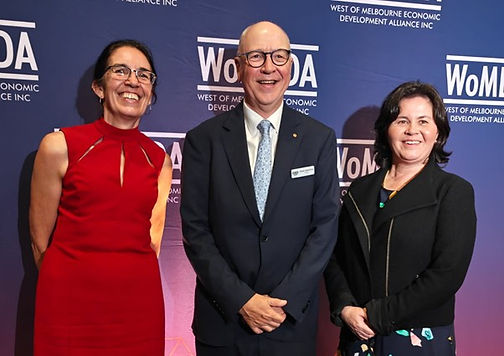
Being photographed with the economic powerhouses of Peter Dawkins, an Emeritus Professor of Economics, and Dr Janine Dixon, who heads the Centre of Policy Studies. The photo shared here was at the launch of the West of Melbourne Economic Development Alliance’s (WoMEDA’s) Strategic Foundations Paper, which I had a hand in pulling together. More on this under the ‘Informing strategies’ header below.
-
The release of research I led for the Australian Accounting and Assurance Public Policy Committee (AAAPPC) on attracting the next generation of accounting and finance professionals. Skip to the next header, ‘Analysing professional labour markets’, for more on this.
-
Sitting on a discussion panel following the release of Victoria’s Budget with heavyweights Chris Barrett, Secretary of the Victorian Department of Treasury and Finance, David Hayward, an Emeritus Professor with RMIT and public policy guru, and Ian Trevorah, Deloitte’s Victorian Office Managing Partner. I can’t recall ever being so fearsome about whether I’d have anything coherent and interesting to say. But, as it turns out, getting me to shut up was the bigger problem. I subsequently captured my contributions in an article shared here.
-
Continuing to be included on the Victorian Government’s Professional Advisory Services (PAS) panel, following a refresh. Call out to all the Victorian public servants in my network: if you are in need of a fresh head and (modestly) keen mind on an economic, policy or strategic matter, I’m your gal!
Analysing professional labour markets
My inner economic nerd is increasingly intrigued by the labour markets of the various professions. As I have now delved into the dynamics of a number, I am finding that they typically have points in common. One is that the demands of employers don’t start and stop at the technical skills and knowledge of professionals. For example, it is necessary but not sufficient for a taxation professional to be across the relevant tax law, standards and practices of the profession. Employers are also interested in qualities like their AI and data analytical abilities. Both of these skills came in ahead of specialist taxation technical skills in a recent Deloitte’s survey of employers globally. AI skills did not even feature in the survey the year prior, which is indicative of just how quickly employer demands can change. Couple this with the growing numbers that employers are demanding in some professions, it is somewhat unsurprising to find that supply is struggling to keep up. Particularly when a further point of commonality is that in most professions it takes time to earn your stripes. Conveniently sticking with the example of taxation professionals (which I know something about thanks to some recent work), a pathway many will follow is a three or four year degree in accounting, further study and work experience requirements to earn a professional accounting designation, followed by even more study to specialise in taxation. From a policy perspective, migration is an important means of immediately addressing shortages. A longer term solution involves working deliberately to attract and support the domestic pipeline.
This is why a highlight for me during the year was the release of research I had undertaken on attracting the next generation of accounting professionals. That research revealed declining levels of engagement in studying accounting in the senior secondary years. While this is Australia-wide, the declines are steepest in government schools and in regional and remote areas. The unhelpful perceptions of accountants, not knowing what accountants do, and unenticing curriculums in some jurisdictions are powerful dissuaders. But even were they not, it is difficult to study accounting when increasing numbers of schools do not offer it as an elective. The good news is that these are not unsurmountable barriers. And the even better news is that many within the ecosystem of influences on students choices, particularly the professional accounting bodies, are doing something about them. You can access a summary of the research on the AAAPPC website and request a full copy via the contact page. I spoke to my findings at an international webinar last year. Opportunities to share the same with a local audience may emerge this year. I’ll keep you posted.
The urgency for action was underscored by some number crunching I undertook for a couple of clients on students studying higher education programs of accounting. The spoiler is that student numbers remain depressed. That said, there is an inkling of hope as domestic student commencements inched up in 2024. However, it is too soon to label this a trend. For it to become so will require sustained efforts by all.
It is not just the demand and supply dynamics of professional labour markets that is interesting, it’s their gendered composition. On second thoughts, I think a stronger word than ‘interesting’ is called for: it is ‘shocking’! It is shocking how little has changed over 30 years, both in Australia and overseas. Men continue to dominate professions that use their heads, such as scientists and engineers, while women dominate those that engage their hearts, such as nursing. So shocking that I felt the need to vent in an article shared on my website. But, before I turn you off, it is not all venting. That article concludes that change is possible. It shares a quick ‘herstory’ of how the number of female accounting professionals has grown from zero to hero (just over half). Over time women have debunked misconceptions and proved it is possible to have hard heads and warm hearts. The same also applies to men contemplating careers in female dominated professions.
Helping to make best use of skills
Currently in Australia the skills of too many are underutilised: 35 percent of Australian born workers and 44 percent of recent migrants are employed in roles below their skill levels. In my 2024 review I shared with you research and advice I was involved in designed to make better use of refugees’ skills faster. Last year I got to cast the net both wider and consider the underutilisation of the skills of all and, separately, more narrowly by looking into how this situation is exacerbated in the regions.
Why is this important? Because a better tomorrow will be achieved when people are in roles that make best and full use of their technical and employability skills. People gain from doing, and getting paid for, what they are good at. Employers benefit from the improved outputs of capable and content staff. Fiscal pressures are eased through reduced welfare dependency. And as productivity improves, regions develop and the economy grows.
There are a host of reasons that explain skills underutilisation. One of them is because people’s technical and/or employability skills are insufficiently recognised. The former may be due to having no, old or overseas qualifications. Regarding the latter, there may be little to evidence employability skills, particularly recent migrants’, and/or there may be gaps. The good news is that there are things that can be done to verify skills and signal skills and address gaps, including recognising prior learning and/or training. Optimally it involves many in the skills ecosystem – government, education and training providers, assessment bodies and industry – working together for a better tomorrow.
Challenging the migration rhetoric
Migration has emerged from out of the political shadows. But too often it is an unflattering light that is being shone. Particularly when it comes to overseas students and graduates. The disinformation that has come to dominate media and political discourses would have you believe that migration is the root cause of many evils. And, unfortunately, too many are buying it, with public support for migration and multiculturalism taking a hit. The latest Social Cohesion report finds that the majority now regard migration as ‘too high’, and that public opinion on the benefits of multiculturalism is on a downwards slide. This is creating a vicious cycle where the media and politicians are pandering to public opinion.
Frustrated, I felt compelled to set the record straight. In my 2024 review I shared details of a Migration Myths Busted presentation I was invited by a client to give. In 2025 I turned that presentation into an article which was published in the public policy eNewsletter, The Mandarin. If you can’t access it there, I also shared it on my website.
I subsequently honed my focus on international education. I asked ‘What is really happening to international education?’ and fact-checked six assertions. Here is what I found.

None of the verdicts provide grounds for the engineered reduction in international students which policies introduced over recent years are designed to do. In a presentation delivered to a client audience, which I subsequently turned into an article you can access on my website, I suggest alternative policy foci.
While politicians are feeding and pandering to public opinion it is not always immediately clear what they really think. One Nation is clearest on what it thinks, having an explicit policy on migration. This is one of the reasons behind its recent elevation in the polls. The Liberal Party is more difficult to fathom largely because, while a few have been vocal about where they stand, they are not voicing a shared Party view. A Party view, I hasten to add, that we keep being promised, yet are still to see. That said, it is the Labor Government’s position that is most difficult to make heads or tails of. Having worked in government policy for more years than I care to commit to paper, I would be surprised if they were not receiving balanced advice. My suspicion is that they are torn between the public sentiment and that advice. Which would explain why there are policies that clamp down in migration, such as tightened conditions for temporary skilled migration, and policies that either maintain the status quo, such as rolling over the cap on permanent migration, or sneak more in, such as the recent Pacific Engagement Visa which sits outside of the Migration Program. I shared my ponderings at a client event. And plan to turn them into an article. Watch this space.
Informing strategies
In my last review I commented how work ramping up on this front was not an unwelcome development. In 2025 the three matters I mentioned in that review - facilitating a strategy day for the Board of a network of finance researchers, working with a major TAFE on its strategy for financially sustainable growth, and crafting the strategic foundations for the economic development for Melbourne’s West – continued to keep me happily busy. I was invited back to facilitate another strategy day. I completed a growth strategy covering foundation, vocational training and higher education for my TAFE client. And I got a Strategic Foundations Paper out the door.
The picture gracing this review was taken at a Summit, jointly hosted by WoMEDA and The Age, where the Paper, Western Growth - Unlocking Melbourne’s Economic Engine, was launched. WoMEDA is an alliance of local governments and other significant institutions operating across the West of Melbourne who are working in tandem to advance a vision where the region is prosperous – a beacon of jobs, opportunity, liveability and sustainable growth. As I live in Melbourne’s West, and have done so now for over two decades, I viewed the request to assist with the Paper’s development as an opportunity to give back to a community I love.
The West of Melbourne is booming. It is big and, with the fastest growing population in Australia, it is rapidly getting bigger. But it is suffering growing pains that, if ignored, may cause boomtime conditions to bust. Pressingly, strategic action is essential to easing the reality where a high and growing share of the West’s population commutes out of the region for work, suffering congested conditions, which not only impacts quality of life, but the environment. The Paper identifies priorities under the six pillars of city building, transport, jobs and skills, industry, liveability, and economic and social inclusion. These priorities are put forward, not as fait de complis, but as the basis for further analysis and a dialogue with the three tiers of government.
In other words, this work is continuing. And I am pleased to say that it will continue to keep me out of mischief in 2026.
Supporting business case development
Supporting the development of business cases has occupied more of my time in 2025 than in previous years. And, I have to confess, I don’t mind that at all. There is nothing I like better than turning my brain to new things and exploring the benefits, drawbacks and feasibility of what is being proposed. I guess I just like arguing (just ask my husband).
A couple of highlights from last year were working alongside another consultant on a government client’s proposal to extend their functions into evaluation, and contributing to a client’s bid to continue and expand its government authorised assessment functions.
Looking ahead
DXP Consulting was still alive in 2025, and has a lot of living to do in 2026. I started out on my own way back in 2017, and feel mighty spoilt that I get to continue to do what I love to this day. I gain a great sense of fulfillment from working with others to make a difference. And, so long as it continues to pay the bills, I intend to keep on doing it.
“Enjoy life. This is not a dress rehearsal." (Friedrich Nietzsche)
Happy 2026!
Mary Clarke
Principal
DXP Consulting
M: +61 401 088 571
E: mary.clarke@dxpconsulting.com.au